

You can grind a dungeon for six hours without blinking. Farm the same location 200 times chasing a rare drop. Run the same raid boss until your fingers forget what sleep feels like.
Then you try to build one real-life habit — wake up 30 minutes earlier, do 20 push-ups, write for 15 minutes — and you quit by day four.
That’s not weakness. That’s not laziness. That’s a missing feedback loop.
Why the Game Grind Works (And Real Life Doesn’t)
Every RPG is built on one core mechanic: visible progress. You hit a monster, a number pops up. You gain XP. The bar moves. You level up — and the screen celebrates you with lights, sounds, and new stats.
Real life gives you none of that. You do 20 push-ups. Nothing happens. The mirror looks the same. No XP bar. No level-up notification. No confirmation that what you just did even mattered.
Your brain — which runs on dopamine and feedback — gets nothing. So it files the whole experience under “pointless” and moves on to something that does give a signal: social media, YouTube, another run in the game that actually tells you you’re winning.
This isn’t a character flaw. It’s game design doing exactly what it was built to do — and real life failing to do the same.
The Gamer’s Discipline Problem Isn’t Motivation
The self-help industry will tell you to get motivated. Find your why. Visualize success. Build a morning routine. Buy a planner.
That’s all noise.
Motivation is a passive stat — it fluctuates based on your mood, your sleep, what you ate, whether you had an argument. Discipline is an active skill. And like any skill in an RPG, it doesn’t level up by wanting it harder. It levels up by doing the action repeatedly with visible feedback.
The grind works in games because it’s designed to be self-reinforcing. The grind fails in real life because it’s designed by nobody — it’s just raw effort with no return signal.
Want a system with a real feedback loop — not motivational advice, but actual mechanics? Try PORTAL →
How to Build the Feedback Loop
You don’t need willpower. You need a system that gives your brain what games already give it:
1. Make the XP Bar Visible
Track the action, not the outcome. Don’t track “lose 5kg” — track “completed workout: day 1, day 2, day 3.” The streak IS the XP bar. When you see it growing, your brain registers progress even before the mirror changes.
Paper tracker, a habit app, marks on a whiteboard — format doesn’t matter. Visibility does.
2. Set the Difficulty to Grinding Level, Not Boss Level
Most people fail habits because they start at the wrong difficulty. They go from zero to “I’ll work out for an hour every morning.” That’s a boss fight with a level-1 character.
Start with grind mechanics: small, repeatable, low-resistance actions. 10 push-ups. One page. Five minutes. Actions you can complete on your worst day. The point isn’t the action — it’s training the system to fire.
3. Build a Loot Drop
Games give you drops after the grind. Real life doesn’t do this automatically — you have to build it in.
After 7 days of completing your habit: give yourself something. A small reward. Not food if it’s a fitness habit — but something that your brain actually wants. An hour of uninterrupted gaming. A specific thing you’ve been postponing. A ritual that signals “you completed the arc.”
You’re not bribing yourself. You’re closing the feedback loop that your brain expects.
4. Name the Character, Not the Habit
Don’t think “I need to exercise.” Think: “My character has a Strength stat and it’s been at base level for three years.”
This sounds like a semantic trick but it isn’t. Identity framing works because it detaches the action from mood-based motivation and attaches it to role-based consistency. Gamers know this intuitively — you don’t feel like grinding, but your character needs the XP, so you do it anyway.
The Real-Life Grind Is Just a Game with Worse UI
The mechanics are identical to any RPG you’ve put 500 hours into:
- Repeatable action → XP gain
- XP gain → level up
- Level up → new abilities unlocked
- New abilities → harder content accessible
The only difference is that real life ships without a UI. No health bar, no progress indicator, no notification when you level up. Your job is to build the UI yourself — or use a system that already has one built in.
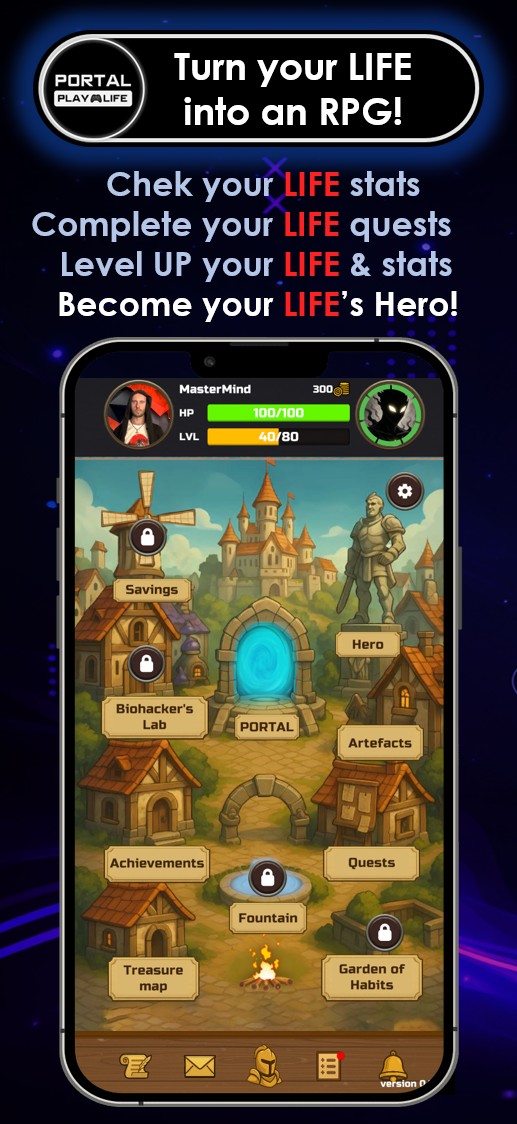
PORTAL exists for exactly this reason. It’s the feedback layer that real life forgot to ship with. Your habits become quests. Your actions generate XP. Your character has real stats that move when you grind the right things.
If you’ve been stuck at the same level for too long — not because you’re weak, but because the game never told you that you were winning — start building your real-life character here.
The grind was never the problem. The missing feedback loop was.